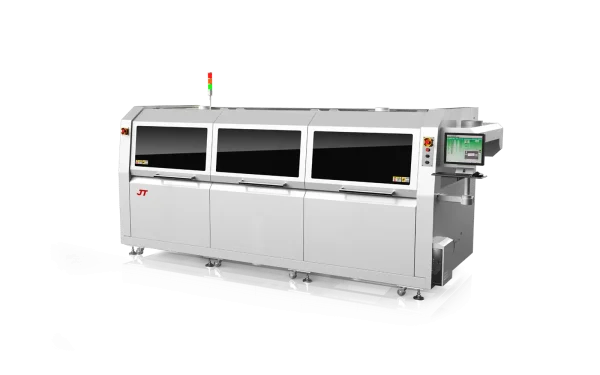

Vacuum reflow ovens represent a pivotal advanced soldering technology in modern electronics manufacturing, creating a low-oxygen, low-pressure environment to achieve high-quality solder joints. As the electronics industry evolves toward miniaturization, high reliability and multi-functional integration, this equipment is shifting from niche high-end applications to mainstream production, with broad development prospects driven by technological innovation and market demand expansion.

The primary growth driver is the surging demand for high-reliability electronics. In automotive electronics, aerospace, medical devices and 5G communication sectors, void-free solder joints are critical for stable long-term performance. Vacuum reflow technology effectively reduces solder voidage to below 5%, far superior to traditional reflow methods, enhancing thermal conductivity, electrical performance and mechanical strength. The rapid rise of new energy vehicles and SiC/GaN power modules further amplifies this demand, as these devices require exceptional heat dissipation and anti-oxidation capabilities that only vacuum soldering can provide.
Market data confirms strong growth momentum. The global vacuum reflow oven market reached approximately $128 million in 2024, projected to grow at a 3.8%-4.7% CAGR to $165-179 million by 2031. Asia-Pacific dominates with 69% market share, fueled by China’s robust electronics manufacturing expansion. Meanwhile, advanced packaging trends—including AI chips, HBM and 3D packaging—create new opportunities, requiring precise temperature control and ultra-clean vacuum environments.
Technological advancement will reshape industry landscape. Future equipment will feature higher precision (temperature control within ±1°C), smarter automation with real-time parameter monitoring, and integration with Industry 4.0 systems. Vacuum combined with formic acid flux-free technology is gaining traction, eliminating post-soldering cleaning and reducing environmental impact. Domestic manufacturers are accelerating technical breakthroughs, driving domestic substitution that may push localization rates above 60% by 2028.
Challenges remain, including high equipment costs and complex process parameters limiting SME adoption. However, ongoing cost optimization and simplified operation systems will gradually mitigate these barriers. As quality standards rise and high-power electronics proliferate, vacuum reflow ovens will become indispensable in advanced manufacturing. With continuous technological iteration and market expansion, this sector is poised for stable, long-term growth, becoming a cornerstone of next-generation electronics assembly.