Commercially, there are two main soldering methods—reflow soldering and wave soldering. “Manual” soldering can still be used for some mechanically complex or large components, but this is very rare. “Manual” soldering can even involve using robots, especially for highly skilled individuals.
Wave soldering involves sending a stream of molten solder along a carefully preheated circuit board. Circuit board temperature, heating and cooling profiles (non-linear), solder temperature, wave shape (uniform), solder residence time, flow rate, circuit board speed, etc., are all important factors affecting the soldering result. Pad shape and component orientation are crucial, and component obstruction must be avoided. For good soldering results, circuit board design, layout, component placement, pad shape and size, heat dissipation, and other aspects need careful consideration. If SMD components are used, they need to be held in place—using specialized quick-drying adhesives or other special methods.

Clearly, wave soldering is a high-intensity, demanding process—so why use it?
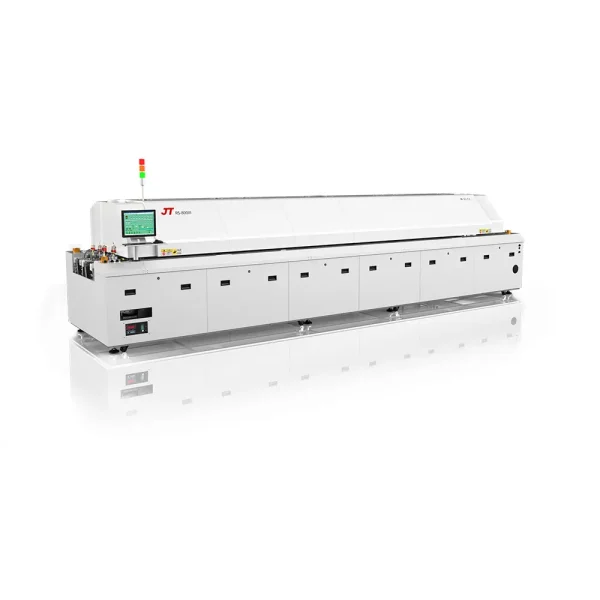
Reflow soldering is widely used because it is the best and most economical soldering method when conditions permit, and in some cases, even the only feasible one. For through-hole components, wave soldering is usually the preferred method.
Therefore, reflow soldering has lower requirements for pad shape, pad shading, board orientation, and temperature profile (although the temperature profile is still very important). For surface mount components, reflow soldering is often a very good choice—a mixture of solder and flux is pre-applied via a stencil or other automated process, and the solder paste usually holds the component well once it is placed in place. In more demanding cases, adhesives can be used. However, for through-hole components, reflow soldering presents problems, or worse—it is generally not the preferred soldering method for through-hole components.
When conditions permit, reflow soldering is preferred over wave soldering. It is better suited for small-batch production and is generally easier to solder for surface mount components.
Complex or high-density circuit boards may use a combination of reflow and wave soldering, with components with leads mounted only on one side of the PCB (called side A) for wave soldering on side B. Before inserting through-hole components, reflow soldering can be performed at the locations where the through-hole components are pre-installed on side A. Afterwards, other SMD components can be added to side B and wave soldered together with the through-hole components. Some users seeking ultimate performance might attempt complex mixed soldering with solders of different melting points, thus requiring reflow soldering of side B before or after wave soldering, but this is very rare.
Incidentally, while hand soldering is slow and expensive, it is the least demanding of all soldering processes because it typically utilizes computational capabilities to flexibly control relatively rudimentary soldering tools. However, the heating accuracy and temperature profiles of hand-soldered components are relatively poor. Certain modern components (such as Nichia SMD LEDs with silicone rubber lenses) must be reflow soldered (according to the datasheet) and cannot be hand-soldered or wave-soldered.