
Reflow soldering serves as the core welding process in SMT assembly, and solder alloy composition directly determines the soldering temperature profile, joint reliability, wettability and production applicability. With the upgrade of environmental regulations and electronic manufacturing standards, solder alloys for reflow soldering have evolved from traditional tin-lead systems to diversified lead-free systems, adapting to various PCB and component requirements. This article introduces the most widely used solder alloy types in modern reflow production.
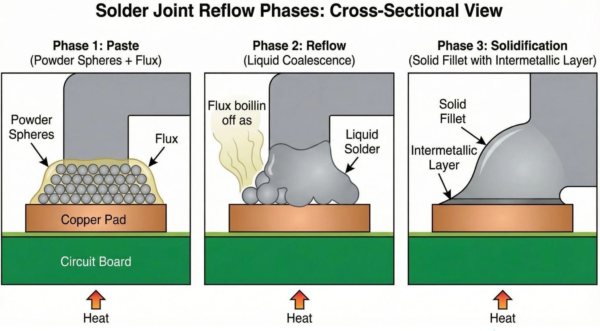
Tin-lead (Sn-Pb) alloy is the traditional classic solder material for reflow soldering. The representative eutectic alloy Sn63Pb37, composed of 63% tin and 37% lead, has a fixed melting point of 183°C with no plastic temperature range. It features excellent wettability, stable fluidity and low surface tension, enabling it to form smooth, void-free solder joints easily. In addition, Sn-Pb alloy costs low and boasts good thermal fatigue resistance, ensuring high soldering yield and stable electrical conductivity. Although restricted by RoHS environmental standards, it is still applied in high-reliability fields such as aerospace, military and precision industrial equipment where environmental rules give priority to performance.
Tin-silver-copper (SAC) alloy is the mainstream lead-free solder for modern reflow soldering. As the most commonly used model, SAC305 consists of 96.5% tin, 3% silver and 0.5% copper, with a melting point of 217°C. It delivers balanced performance with outstanding mechanical strength, anti-oxidation capacity and thermal stability. SAC305 solder joints resist cracking and deformation under high-temperature and alternating load conditions, making it suitable for mass production of consumer electronics, communication devices and automotive electronics. Another upgraded variant SAC387 offers better wettability and higher reliability for high-end precision assembly.
Tin-copper (Sn-Cu) alloy represented by Sn99.3Cu0.7 is a cost-effective lead-free alternative. With a melting point of 227°C, it has a simpler composition and lower cost than SAC series alloys. Though its wettability and ductility are slightly weaker, it meets the basic reliability requirements of ordinary electronic products. It is widely used in low-cost, non-high-precision SMT mass production such as household appliances and conventional circuit boards.
Low-temperature bismuth-containing alloys are specially designed for heat-sensitive components. The typical Bi-Sn-Ag alloy melts at approximately 138°C, greatly reducing the reflow peak temperature. It effectively avoids thermal damage to flexible PCBs, LEDs and miniature sensitive components, solving the welding failure problem caused by high temperature in traditional lead-free processes.
In conclusion, the selection of reflow solder alloys depends on product positioning, component heat resistance and environmental standards. Reasonable alloy matching guarantees efficient production and long-term stable operation of electronic assemblies.