
The EU’s RoHS standard requires all electronic products to be lead-free (Pb < 0.1%). The US, Canada, China, and other countries have also established similar lead-free standards. Lead-free is a systemic requirement, encompassing lead-free components, lead-free PCBs, and lead-free reflow soldering.
Lead-free reflow soldering is a key process in lead-free PCB assembly. This article comprehensively introduces lead-free reflow soldering, including the process flow, reliable lead-free assembly solutions, and the advantages of lead-free reflow soldering.
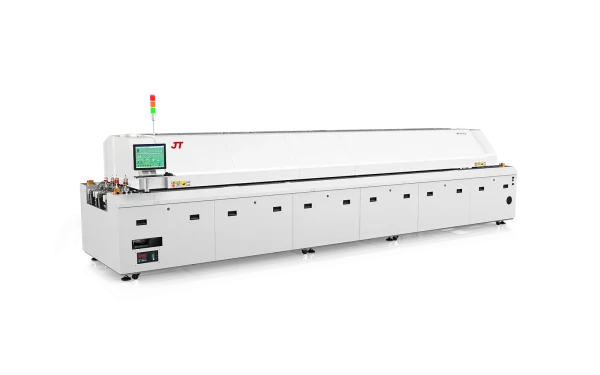
Part 1: What is Lead-Free Reflow Soldering?
Lead-free reflow soldering refers to the process in which lead-free solder paste is melted and solidified onto the PCB pads by adjusting the temperature of the reflow oven during PCB assembly. After the PCBA cools, SMD components are soldered onto the PCB pads.
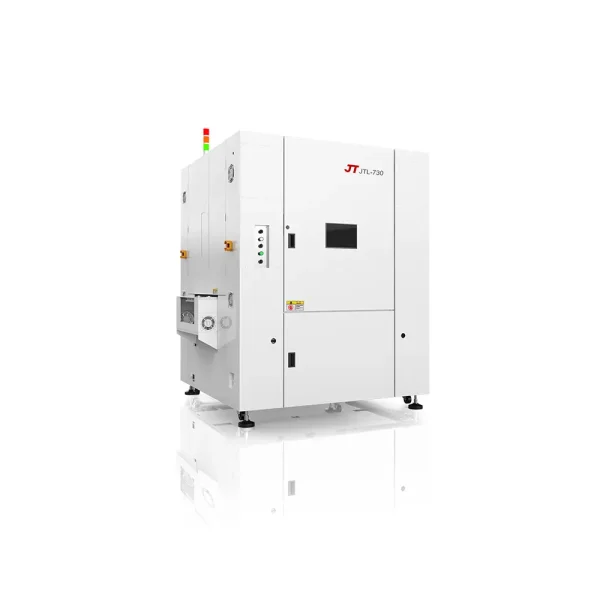
Lead-free reflow soldering is fully automated and performed in a lead-free reflow oven with ten temperature chambers (tin-lead reflow ovens have eight). The reflow oven uses nitrogen gas to raise the temperature. In a lead-free reflow oven, PCBAs are conveyed by a conveyor belt and undergo four stages:
1. Preheating Stage: As the PCBA enters the lead-free reflow oven, it is slowly preheated at a uniform rate to remove moisture and solvents from the solder paste. This is also to prepare for reflow soldering, preventing problems such as thermal shock damage to SMD components, incomplete soldering of PCB pads, solder balls appearing in non-soldered areas, and solder splatter.
The preheating temperature for lead-free reflow soldering is approximately 150°C to 190°C, with a preheating rate of approximately 0.75°C/second to 2°C/second. The preheating stage lasts approximately 60 to 120 seconds.
2. Immersion Stage: The reflow soldering immersion stage involves removing moisture from the solder paste and activating the flux to prepare for soldering. Simultaneously, oxides on the surfaces of components and PCB pads are removed. The temperature rise rate in the immersion stage is slower than in the preheating stage.
Lead-free reflow soldering can reach a holding temperature of approximately 217°C, with a heating rate of approximately 0.5°C/second to 1°C/second. The lead-free holding phase lasts approximately 60 to 120 seconds.
3. Reflow Soldering Phase
The reflow soldering phase refers to the complete reflow of the solder paste. The temperature of lead-free reflow soldering is approximately 240°C to 248°C. Before reaching the peak temperature, the solder paste melts and wets the PCB pads and components. The reflow oven maintains the peak temperature for a period of time to ensure the solder paste reflows and to maintain a uniform temperature throughout the PCBA in case of a pillar effect.
The lead-free reflow soldering phase lasts approximately 40 to 70 seconds, with the peak temperature lasting approximately 10 to 30 seconds.
3. Cooling Phase
The reflow soldering cooling phase refers to the process where the temperature in all areas of the reflow oven drops from the peak to 75°C, the solder solidifies, and the components and PCB pads are firmly soldered. The cooling rate should be approximately twice the preheating rate to avoid PCB component bending and solder joint burrs. Part Two: Lead-Free Reflow Soldering Process
A lead-free reflow soldering profile is generated based on temperature data collected from the reflow oven temperature test board. This reflow oven is connected to DATAPAQ and tested using the reflow oven.
The lead-free reflow soldering process profile reflects the four stages of the reflow soldering process described above. The specific specifications of the lead-free reflow soldering process profile depend on the melting point of the solder paste and the maximum temperature that the PCB laminate can withstand.
Common lead-free solder paste uses Sn96.5Ag3Gu0.5 alloy powder, with a melting point of 217°C.
Part Three: Lead-Free Reflow Soldering vs. Tin-Lead Reflow Soldering
The differences between lead-free reflow soldering and traditional tin-lead reflow soldering are:
1. Lead-free reflow soldering requires the use of lead-free solder paste, such as tin-copper alloy solder paste or tin-silver alloy solder paste.
2. The lead-free reflow soldering temperature is approximately 30°C higher than the traditional tin-lead reflow soldering temperature.
3. Lead-free reflow ovens can perform both lead-free and lead-tin assembly. Lead-tin reflow ovens cannot assemble lead-free PCBs.
4. The allowable reflow temperature fluctuation range for tin-lead reflow soldering is 30°C, while the allowable fluctuation range for lead-free reflow soldering is only 5°C.
5. The heating rate of lead-free reflow soldering is higher than that of lead-tin reflow soldering. Lead-free reflow soldering is more difficult than tin-lead reflow soldering.
Part Four: Advantages of Lead-Free Reflow Soldering
Compared to traditional tin-lead PCB reflow soldering, lead-free reflow soldering has the following advantages:
1. Compared to tin-lead reflow soldering, nitrogen flow is more uniform in the lead-free reflow soldering process. This reduces the temperature tolerance of the PCB board and achieves better soldering results.
2. Lead-free reflow ovens can be used for lead-free reflow soldering, tin-lead reflow soldering, chip aging, and red glue curing.
3. Lead-free reflow soldering offers more precise temperature control than tin-lead reflow soldering, with an accuracy of approximately ±2℃.
4. Lead-free reflow soldering is non-toxic, produces less pollution than tin-lead reflow soldering, and allows for nitrogen recovery.