• Definition
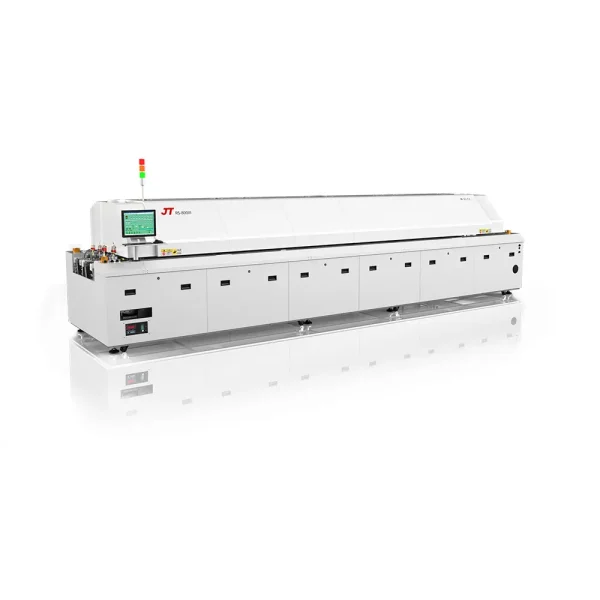
As its name depicted, wave soldering is used to combine PCB and parts through a liquid “wave” formed as a result of motor agitation and the liquid is actually dissolved tin. It is carried out in wave soldering machine. The image below demonstrates a sample wave soldering machine.

• Soldering Process
Wave soldering process is composed by four steps: flux spraying, pre-heating, wave soldering and cooling.
Step one: Flux Spraying. Cleanliness of metal surface is the basic element ensuring soldering performance, depending on functions of solder flux. Solder flux plays a crucial role in smooth implementation of soldering. Leading functions of solder flux include:
1) To eliminate oxide from metal surface of boards and components’ pins;
2) To stop circuit boards from secondary oxidation during thermal process;
3) To reduce surface tension of solder paste;
4) To transmit heat.
Step two: Pre-heating. In a pallet along a chain similar to conveyor belt, PCBs travel through a heat tunnel to carry out pre-heating and activate flux.
Step three: Wave Soldering. As temperature constantly rises, solder paste becomes liquid with a wave formed from whose edge boards will travel above and components can be solidly bonded on boards.
Step four: Cooling. Wave soldering profile conforms to a temperature curve. As temperature reaches the peak in wave soldering stage, its reduction comes, which is called a cooling zone. After being cooled to room temperature, board will be successfully assembled.
As circuit boards are placed on pallet ready to go through wave soldering, time and temperature are closely associated with soldering performance. As far as time and temperature are concerned, a professional wave soldering machine is of much necessity while PCB Assembler’s expertise and experience are seldom easy to obtain since they depend on years’ accumulation, application of up-to-date technologies and business focus.
If temperature is set to be too low, flux won’t be melted so that it won’t maintain activity, reaction capability and capabilities to dissolve oxide and dirt on the surface of metal. In addition, alloy won’t be generated by flux and metal if temperature is not sufficiently high. Furthermore, other factors such as speed of band carrier, wave contact time etc. should be taken into considerations and calculation.
Generally speaking, even though the same wave soldering equipment is applied, different Assemblers possibly feature different manufacturing efficiency due to different operation methods and extent of understanding on soldering machine. For example, PCBCart (a China-based full turnkey PCB Assembly service supplier) engineers take advantage of fixture to fix THT components prior to wave soldering so that all parts can be accurately mounted on boards with soldering defects dramatically decreased.
• Application Field
Wave soldering can be accepted by THT (Through-hole Technology), DIP (dual-in-line packaging) assembly and SMT (Surface Mount Technology). It is more used in the former.