
Solder points are small metal connections that connect electronic components to a circuit board. It holds components in place and allows electrical current to flow between them. Solder joints can be found on nearly every electronic device, from cell phones to computers.
If the solder joints are weak or cracked, the device may stop functioning. Bad solder joints can cause loose connections, overheating, and even short circuits. Therefore, good solder joints are crucial to ensure the reliability and service life of electronic products.

Soldering uses a material called a filler metal to join two metal parts. The solder has a lower melting point than the base metal. After melting, the solder flows between the parts, cools, and solidifies to form a strong bond and electrical connection.
Wetting and Bond Formation
A good solder joint requires proper wetting, which means the solder can be evenly spread on a clean metal surface. In this case, a thin bonding layer called the solder layer is formed. Intermetallic Compound (IMC) This helps maintain the strength and reliability of the joint.
Solder Alloy Types
Common solder alloys include tin-lead alloys (Sn-Pb) with a melting point of approximately 183 °C, and lead-free types such as Sn-Ag-Cu (SAC) with a melting point of approximately 217–221 °C. The appropriate type depends on performance and safety requirements.
Surface, Flux, and Heat
Clean surfaces and good flux contribute to good solder adhesion and flow. Flux removes dirt and oxides. Use it correctly. Thermal Control
Temperature is also important—it needs to be high enough to completely melt the solder, but not so hot that it damages the circuit board or components.

Through-hole connectors vs. SMD connectors
- Through-hole connectors: When component leads pass through holes in a PCB and are soldered from the other side, a baffle is used. Baffles provide strong mechanical support and are commonly found for larger or high-power components.
- SMD (Surface Mount Device) connectors: On the other hand, some circuit boards do not require drilling, allowing components to be mounted directly onto the board surface. These boards are smaller and lighter, making them ideal for small electronic products such as smartphones and laptops.

Joint Geometry
Solder joints can take on different forms and shapes, depending on the components and methods used. Common forms include:
- Rounded corner joints – Tapered or dome-shaped joints that connect wires or pads.
- Ball joints – Commonly found in ball grid arrays (BGAs), where small solder balls connect the chip to the circuit board.
- Barrel joints – Commonly found in through-hole components, where solder fills the hole around the lead.

Common Defects and Their Causes
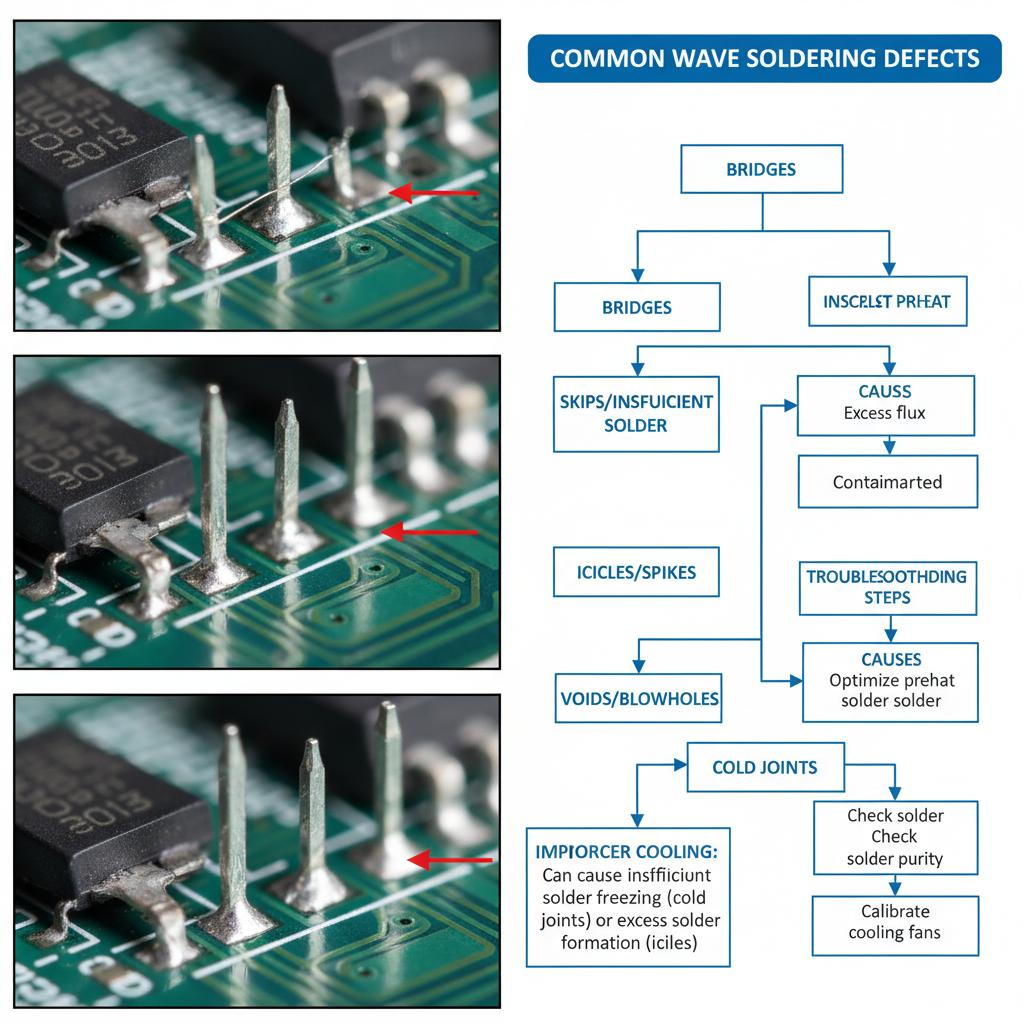
Not all solder joints are perfect. Some common defects include:
- Cold Joints – Poor contact and loose connections due to insufficient heating.
- Dry Joints – Poor wetting due to oxidation or insufficient flux.
- Head on Pillow – Occurs in BGAs when the solder balls and solder paste fail to fuse properly during reflow soldering.
These defects can lead to unstable connections or complete circuit failure, therefore proper handling and inspection are crucial.
Emerging Joint Types
The continuous miniaturization of modern electronic products has given rise to new connection methods such as microelectronics, fine-pitch, and system-in-package (SiP) soldering. These methods require extremely high precision and advanced materials to ensure that strong and reliable connections can be formed even in tiny, high-density designs.